

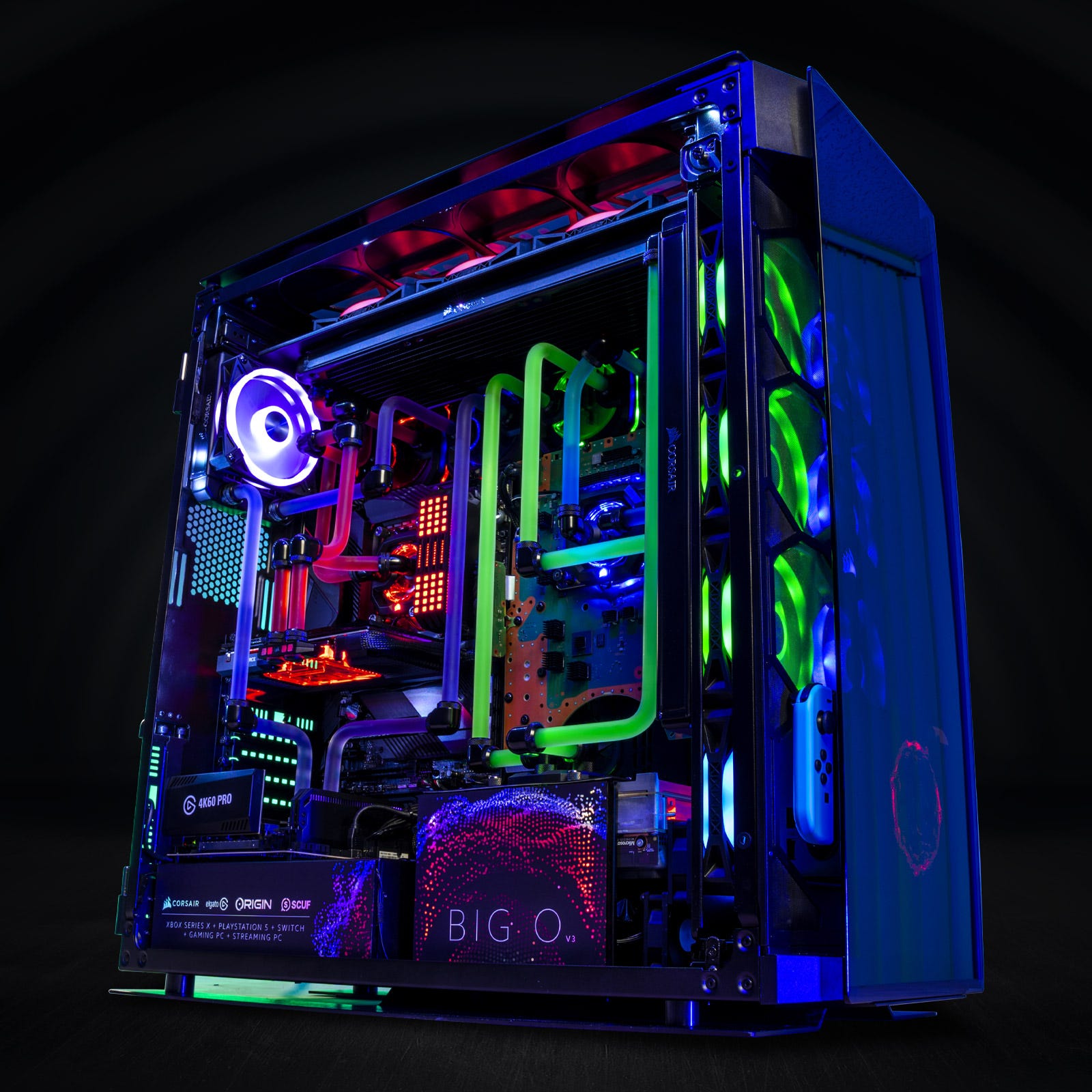
If you’ve been wondering why a hard drive now requires financing, why RAM is beginning to trade like a precious metal, and why a graphics card costs roughly the same as a serviceable used automobile, there are two parties you may thank.
AI.
And Donald Fucking Trump.
Pretty much in that order.
The first problem is that AI companies and data-center operators are presently inhaling the world’s computing capacity like a cocaine enthusiast who has just discovered 1-800-COKEHED.
Microsoft, Amazon, Google, Meta, Musk, OpenAI, Anthropic, and the entire sweating fraternity of data-center impresarios have gone to the manufacturers and said:
“You can continue selling parts one at a time to people who complain on Reddit about a fifty-dollar price increase. Or we can agree, right now, to purchase everything you can manufacture for the next ten years, at margins that would make a heroin look like a bad bet on ROI.”
The manufacturers, after conducting approximately four nanoseconds of soul-searching, selected the second door.
Naturally.
This does not mean Musk is buying RTX 5090s at Best Buy by the pallet. Data centers generally use enterprise accelerators, specialized networking equipment, high-bandwidth memory, server DRAM, advanced storage, and custom chips rather than the exact consumer card you use to play Cyberpunk and maintain your pornography archive.
But this is comfort chiefly for pedants.
All those products compete for many of the same factories, wafers, packaging lines, memory supplies, substrates, engineering talent, electrical equipment, and manufacturing capacity. When Nvidia can sell a data-center accelerator for tens of thousands of dollars, it becomes rather less emotionally invested in making sure Kevin in Sheboygan can buy a gaming card for $899.
Kevin is not a strategic account.
Kevin is a nuisance with a coupon code.
Hence the RTX 5090, a graphics card theoretically priced at roughly two thousand dollars, but frequently appearing in the wild at prices approaching four or five thousand dollars, as though it were handcrafted by Swiss monks and contained the bones of a minor saint.
Why?
Because Nvidia, ASUS, the board manufacturers, the distributors, and every other creature standing between the factory and your motherboard have discovered something important:
Someone will pay it.
And if you will not, some AI company, visualization studio, cloud operator, government contractor, or professionally overcapitalized idiot probably will.
Thus the industry’s new customer-service policy:
Fuck you. Next.
The same pressure is spreading through memory, storage, networking, power supplies, cooling equipment, and advanced semiconductor manufacturing.
AI data centers require obscene amounts of memory. They require enormous numbers of storage drives. They require advanced chips, server boards, switches, transformers, cooling systems, backup generators, and enough electricity to make a medium-sized country ask whether someone has left the oven on.
This is why the AI boom cannot simply be dismissed as another dot-com bubble.
There may indeed be a bubble. In fact, there almost certainly is.
But the bubble is not the existence of the infrastructure.
The buildings are real. The chips are real. The power contracts are real. The factories are real. The hundreds of billions in capital spending are real.
The questionable part is whether the economics attached to all this construction make any fucking sense.
OpenAI, Anthropic, and their competitors are spending fortunes developing systems capable of replacing nineteen employees, then selling access to those systems for the price of a moderately disappointing sandwich.
That arrangement may not survive.
At some point, investors may notice that “losing more money with every new customer” is not actually a revolutionary business model. It is merely a traditional business failure wearing a Patagonia vest.
So yes, valuations may collapse. Companies may merge. Startups may vanish. Venture capitalists may discover, to their astonishment, that not every chatbot deserves a twelve-billion-dollar valuation.
But even if the financial theology disintegrates, the physical build-out has already happened.
The cathedral may be real even when the religion is bullshit.
Factories are being expanded. Long-term capacity is being reserved. Data-center campuses are being planned through the 2030s. Power, chips, memory, storage, and industrial equipment are being contracted years in advance.
That does not necessarily mean every computer component will remain unavailable for twenty uninterrupted years. It means consumers will be standing at the rear of the line whenever demand tightens, because the people at the front are placing billion-dollar orders and Kevin is still waving his coupon.
And then, because apparently the market required another kick in the testicles, we added Trump.
Modern electronics do not emerge from one patriotic American factory in Ohio where a ruddy-faced fellow named Hank pounds silicon into shape beneath a flag.
The supply chain stretches across Taiwan, South Korea, Japan, Malaysia, China, the Netherlands, the United States, and several other countries whose names Trump may or may not be able to identify on a map.
Taiwan remains indispensable to advanced semiconductor manufacturing, particularly through TSMC. South Korea dominates large portions of the global memory business through Samsung and SK Hynix. Japan supplies critical chemicals, materials, equipment, and components. Malaysia is deeply involved in semiconductor assembly, packaging, and testing. China remains central to electronics manufacturing and component supply chains.
This is not a supply chain.
It is an international hostage situation.
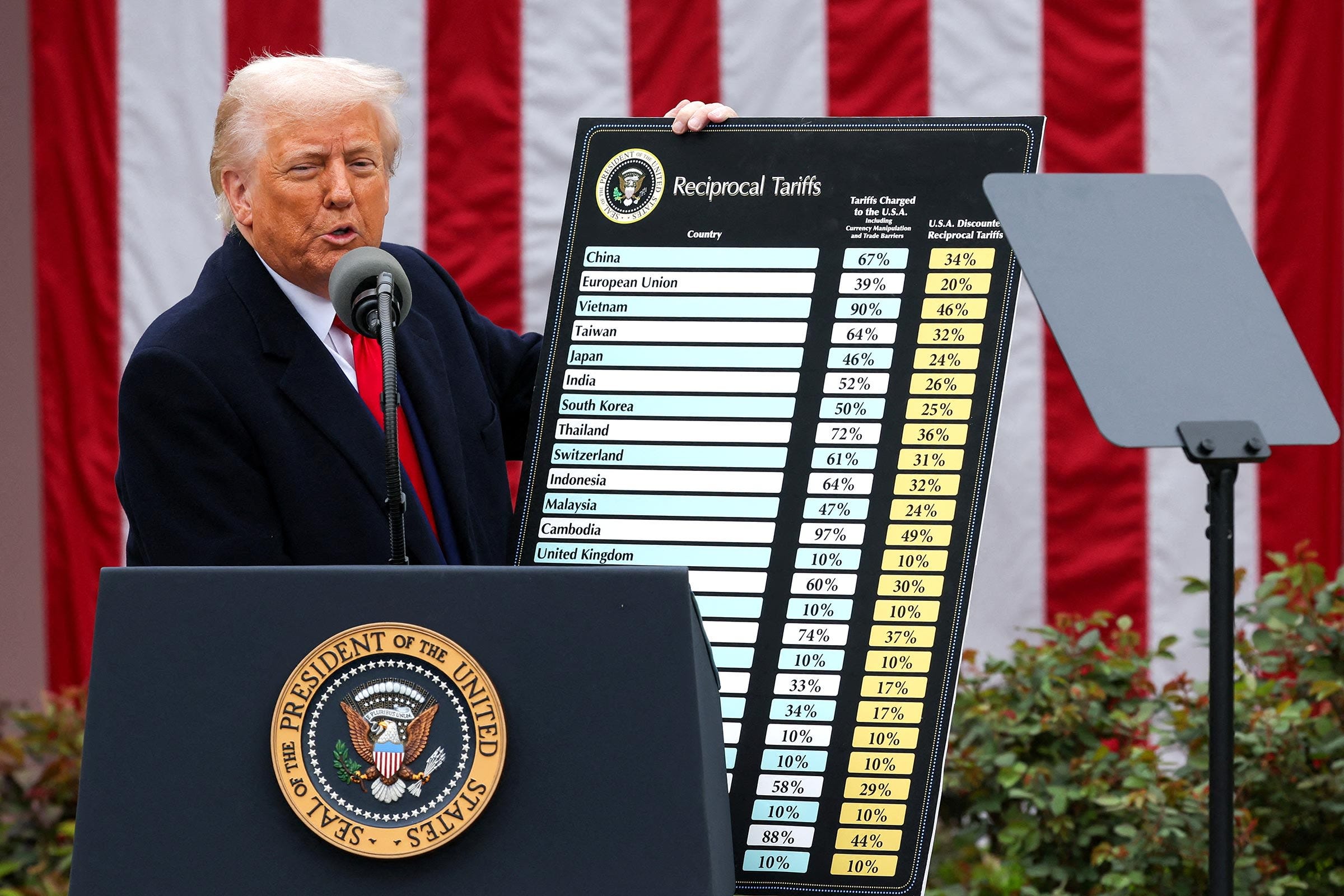
And Trump’s answer to this intricate web of mutual dependency is the same answer he brings to every complicated problem:
Threaten everyone.
Impose tariffs.
Withdraw the tariffs.
Announce new tariffs.
Claim foreigners pay the tariffs.
Discover that American importers pay them.
Blame Biden.
Post something at 2:17 in the morning about winning.
Repeat.
Tariffs and export restrictions do not create advanced semiconductor capacity by presidential incantation. They raise costs, delay investment, encourage hoarding, complicate sourcing, and force companies to spend billions rearranging supply chains that took decades to build.
Some decoupling from China may be strategically necessary. Bringing more semiconductor production to the United States is also sensible. The CHIPS and Science Act was designed precisely because allowing nearly all advanced chip manufacturing to remain concentrated within artillery range of China was generally regarded as a poor long-term arrangement.
But industrial policy requires patience, consistency, technical competence, and cooperation with allies.
Trump offers none of these.
He treats allies like delinquent tenants, supply chains like protection rackets, and international trade as though it were a Queens casino negotiation in which everyone else must be cheating because he cannot understand the invoice.
Taiwan is the great nightmare.
If China blockades or attacks Taiwan, “computer prices will increase” will be among the more cheerful headlines.
Advanced chip supplies would be disrupted. Electronics production would convulse. Automobiles, weapons systems, telecommunications equipment, medical devices, industrial machinery, and consumer computers would all be affected.
Yes, the United States, Japan, Europe, and Taiwan are investing in more geographically dispersed production. Yes, new fabrication capacity is being built outside Taiwan. Yes, some critical equipment and process knowledge can be relocated.
But semiconductor manufacturing is not a lemonade stand.
You do not buy three machines, hire Gary’s cousin, and begin producing five-nanometer chips behind the abandoned Sears.
The facilities cost tens of billions of dollars. The machinery is fantastically complex. The supply chains are specialized. The workforce takes years to develop. Advanced packaging, lithography, memory production, substrate manufacturing, and fabrication each contain their own delightful collection of bottlenecks.
This is why the best analogy is the ammunition market after 2001.
It was not one continuous twenty-three-year shortage caused solely by government orders. It was a series of overlapping wars, military contracts, capacity limits, commodity spikes, political panics, regulatory fears, and later pandemic buying.
But the practical result for the ordinary buyer was familiar.
Whenever demand surged, you were fucked.
The military came first. Law enforcement came next. Large commercial contracts came after that. The civilian walking into a sporting-goods store hoping to buy a box of 9mm received whatever remained, at whatever absurd price the market had devised.
Factories could expand, but they could not instantly double production. New manufacturers could enter, but ammunition production requires machinery, capital, materials, regulatory compliance, distribution, and customers willing to keep buying after the panic ends.
So shelves went bare.
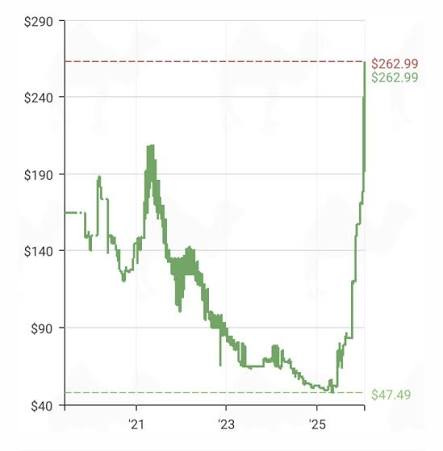
DDR 4 RAM chip prices over the past five years.
Prices exploded.
People began hoarding because supplies were scarce, which made supplies scarcer, which encouraged more hoarding, because humanity’s favorite response to a shortage is to make the shortage worse.
The computer industry is now entering its own version of that cycle.
Only instead of the Pentagon ordering ammunition, data-center companies are reserving chips, memory, storage, electrical equipment, and factory capacity.
And instead of your local gun shop telling you it has no 9mm, Best Buy will inform you that the graphics card you wanted is available from a marketplace seller named ShenzhenDragonCryptoDeals for $4,799 plus shipping.
So whom will NVIDIA serve first?
You, because you would like to play Cyberpunk at 240 frames per second?
Or the data-center operator prepared to purchase forty thousand accelerators, sign a ten-year agreement, and pay immediately at a 20% guaranteed “fuck you” margin?
A difficult decision, surely.
The consumer market will not disappear. Gaming cards will still be produced. RAM will still be sold. Hard drives and SSDs will remain available.
But the old assumption that computing power must always become cheaper, faster, and more abundant is under serious strain.
For decades, consumers benefited from relentless improvements in semiconductor manufacturing and mass-market competition. Now the most advanced capacity is being pulled toward buyers with vastly deeper pockets and far greater urgency.
The likely result is not twenty years in which every computer costs twice as much.
It is something more irritating and more durable:
A structurally higher price floor.
More frequent shortages.
Longer product cycles.
Greater volatility.
Manufacturers deliberately steering their best capacity toward enterprise buyers.
And ordinary consumers being asked to pay premium prices for products that would once have been considered midrange.
Your next computer may cost 30 percent more. Certain components may cost 50 percent more. At the bleeding edge, prices may be 100 percent higher or worse.
And whenever the supply chain suffers another disruption, whether from tariffs, sanctions, war, earthquakes, shipping problems, or some billionaire announcing that he requires an additional million GPUs by Tuesday, you will discover where you stand in the hierarchy.
At the bottom.
But do take comfort.
Eggs were expensive.
Biden was apparently a cuck for supporting domestic semiconductor manufacturing.
And while the adults were trying to reduce America’s dependence on Asian chip production, the nation had more urgent work to perform.
We were busy Nazing, goddammit. We ain’t got time (or money) for cheap PC parts.
Cuck.
Worth the wait for Explicit Explaining’s maiden voyage. Vintage Finnegan!
China's open AI is selling cheap. US software startups are imbedding Chinese AI into software so they can make money. The circular financing the tech bros are sponsoring isn't sustainable. Unless they can sell AI, ooops to our tech bros.